
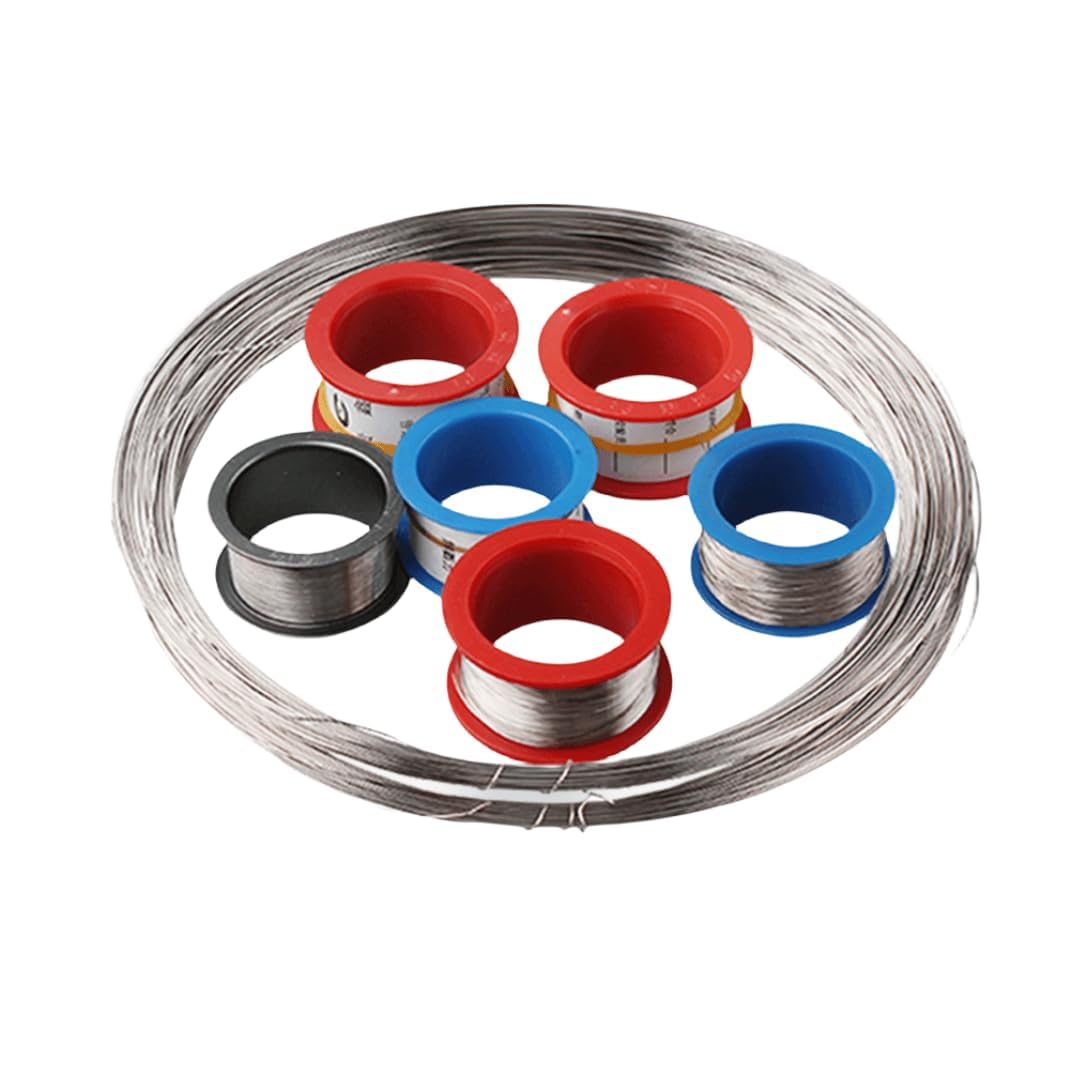
Tungsten-Rhenium Thermocouple Electrode, High Temperature Tungsten-Rhenium Alloy Wire, Diameter 0.5mm,W-Re Alloy WRe5-WRe26 and WRe39-WRe25 (200mm Length, +W95Re5 -W74Re26)
Produktdetails
| Artikelnummer | 220428969 | Erscheinungsdatum | 2026/05/03 | Listenpreis | €13.20 | Modellnummer | 220428969 | ||
|---|---|---|---|---|---|---|---|---|---|
| Kategorie | |||||||||
🟤+ W95Re5-W74Re26: The nominal composition of the positive electrode is 95% tungsten rhenium 5%, and the nominal composition of the negative electrode is 74% tungsten rhenium 26%. , index number WRe5-WRe26, abbreviation :W-Re5/26(ASTM index number :C) ⚫+ W97Re3-W75Re25: The nominal composition of the positive electrode is tungsten-97% rhenium 3%, the nominal composition of the negative electrode is tungsten-75% rhenium 25%, the index number is WRe3-WRe25, abbreviation :W-Re3/25(ASTM index number :D) Tungsten-rhenium alloy has better mechanical properties and ductility than pure tungsten, and high resistivity, so it has better processability and weldability. The main disadvantage of tungsten-rhenium alloy thermocouple is that the electrode is easily oxidized in the oxidizing atmosphere, and the bare wire is not suitable for continuous use in the oxidizing atmosphere The maximum use temperature of Tungsten-rhenium thermocouple can reach 2800°C(5072℉), but the data dispersion will occur when it is higher than 2300°C(4172℉), so the use temperature is best around 2000°C(3872℉) Tungsten-rhenium alloy thermocouple thermoelectric potential value and thermoelectric potential rate large output signal, can improve the measurement accuracy
- 🟤+ W95Re5-W74Re26: The nominal composition of the positive electrode is 95% tungsten rhenium 5%, and the nominal composition of the negative electrode is 74% tungsten rhenium 26%. , index number WRe5-WRe26, abbreviation :W-Re5/26(ASTM index number :C)
- ⚫+ W97Re3-W75Re25: The nominal composition of the positive electrode is tungsten-97% rhenium 3%, the nominal composition of the negative electrode is tungsten-75% rhenium 25%, the index number is WRe3-WRe25, abbreviation :W-Re3/25(ASTM index number :D)
- Tungsten-rhenium alloy has better mechanical properties and ductility than pure tungsten, and high resistivity, so it has better processability and weldability. The main disadvantage of tungsten-rhenium alloy thermocouple is that the electrode is easily oxidized in the oxidizing atmosphere, and the bare wire is not suitable for continuous use in the oxidizing atmosphere
- The maximum use temperature of Tungsten-rhenium thermocouple can reach 2800°C(5072℉), but the data dispersion will occur when it is higher than 2300°C(4172℉), so the use temperature is best around 2000°C(3872℉)
- Tungsten-rhenium alloy thermocouple thermoelectric potential value and thermoelectric potential rate large output signal, can improve the measurement accuracy
| Brand Name | Sinm |
|---|---|
| Part Number | SINM Tungsten-Rhenium Thermocouple Wire |
| Manufacturer | SINM |
| Number of Items | 1 |
| Included Components | Tungsten-Rhenium Wire |
Korrektur der Produktinformationen
Wenn Sie Unvollständigkeiten oder Fehler in den Produktinformationen auf dieser Seite bemerken, nutzen Sie bitte das Korrekturformular unten.
KorrekturanfrageKundenbewertungen
Für dieses Produkt liegen derzeit keine schriftlichen Bewertungen vor.